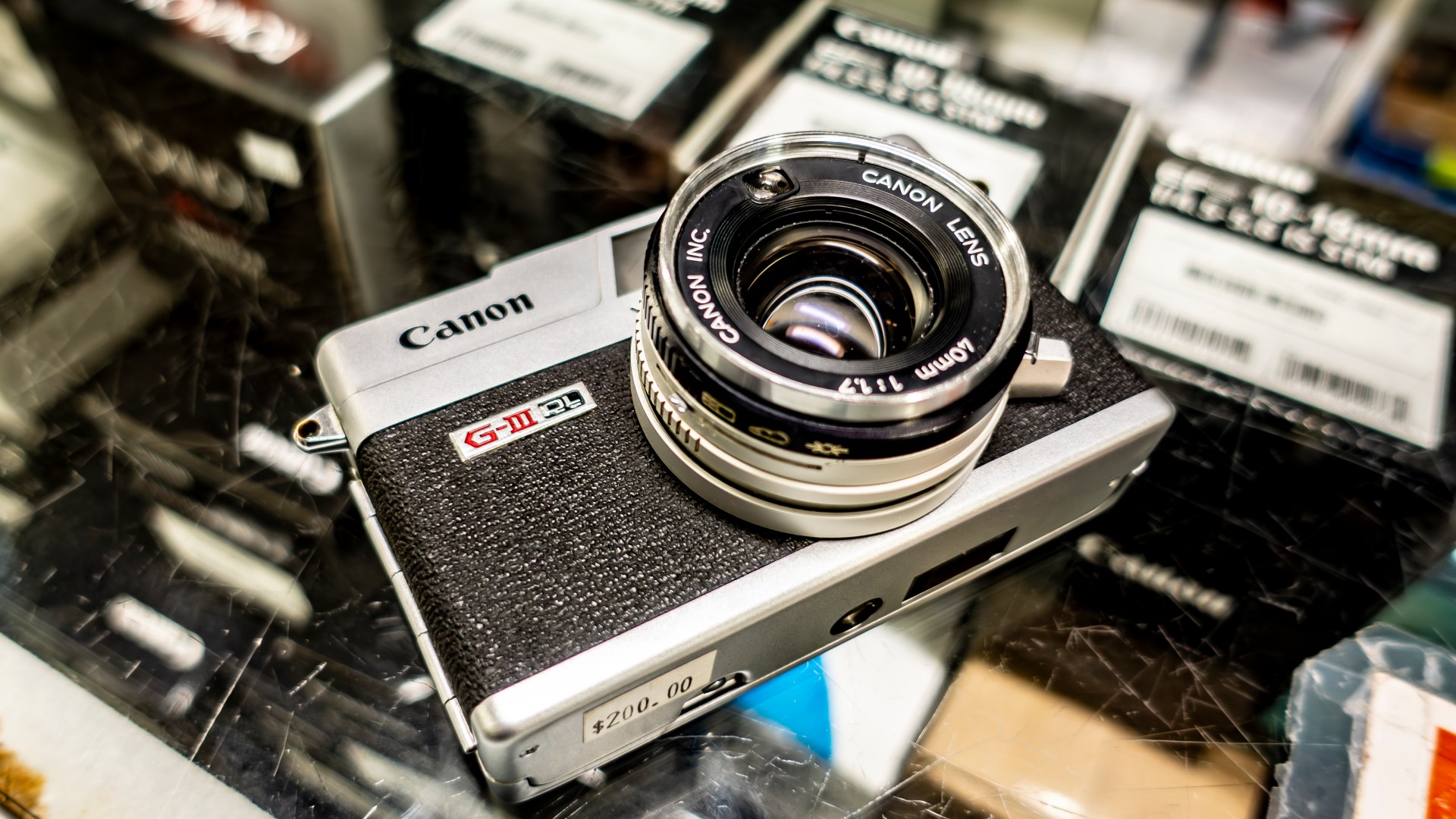
Reversing Regrets: Canon Canonet QL17 GIII.
I recently wrote a post about reversing regrets. A start of a short series. This is one of the decisions that gave me the idea for it. The point of reversing regrets, besides the obvious, is twofold.
- Admitting I was wrong.
- Correcting the situation.
Unlike my last post, I will not be queueing up Mark Morrison’s Return of the Mack. This a fine camera but this return was a bit more serendipity than by design. It is not the camera I planned to return. This was:

The camera that started my obsession with photography as a child. I was so fascinated with my Father’s copy that he bought me a Polaroid One Step of my very own.
What happened was that the two copies the camera shop did not work out. Was likely for the best what with the camera shop telling me that the Impossible project is having issues supplying film right now.
That kind of snapped me out of it by remembering:
- I already have one. Dropped it and it has a crack but likely works fine. I just never bothered to confirm this.
- The reason I never confirmed it was, nostalgia set aside, I was not that jazzed about the experience of taking a picture with it.
- If I am not going to use it to take photos why not use the one I have as a shelf trophy since the crack is nearly invisible.
So I let it go. It was shaping up that the regret would be if I purchased it. It was a store credit swap. And since I was in the space of a trade I took a look around. I am good on film for a minute, the amount I had to spend would not purchase anything interesting of the digital persuasion. I then asked for advice from the crew in the shop and Venu recommended this.

Well hello. I am familiar. So much so that I wrote a KEH blog post about it years ago. I liked it so much that I even accessorized it.
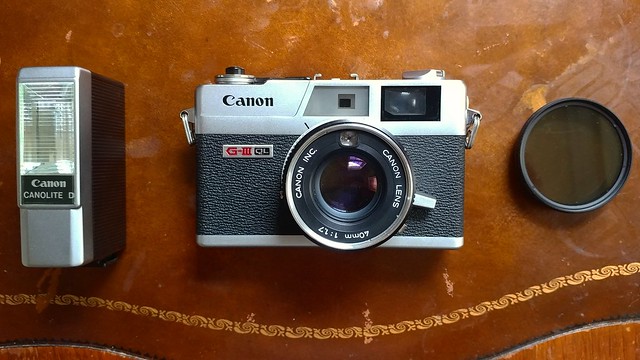
Will pass on the flash and filter this time.
Unlike the mystery as to why I unloaded the SOny ZV-1 I know what happened in this case. I took it out at night and I did not like the results. After all the good images this camera gave me…
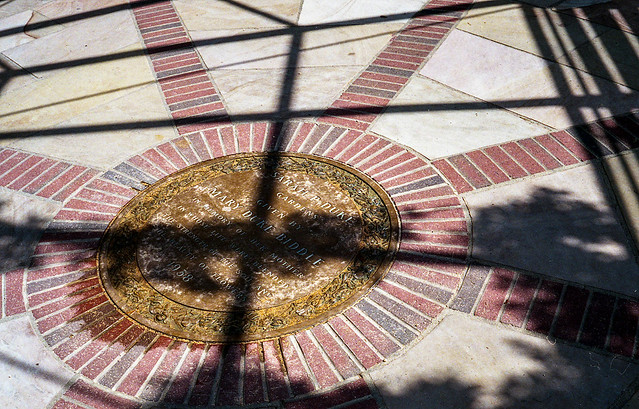
…I let one night change everything. Basically, I was wrong. This time I will embrace ot being a sunny day ,fair weather friend and use it appropriately.
I will restrain myself a bit with this post. It will go like this. A cut and paste of my likes from that KEH post I wrote, some sample images, and some closing thoughts.
Pluses from KEH post.
- Fantastic lens. Just an amazing lens.
- Easy to use exposure meter is spot on. Default is shutter priority when the aperture is set to A where a display in the viewfinder tells you what f stop the camera has chosen.
- Framing lines move with the focus lever to accommodate parallax correction. Simple genius only bested in usefulness by the significantly more complex Contax G series which automagically blocks the captured frame entirely.
- Focus lever is a joy to use. Short, 90 degree throw and perfectly damped. Focus patch is generously sized and the viewfinder is bright.
- Great control set up. Everything right on the lens.
- Hot shoe and PC port w/ a leaf shutter so you get flash sync at all speeds up to 1/500s.
- Very small. And silent. Unobtrusive.
- Nice focal length compromise. 40mm falls right between the 35mm and 50mm focal length camps.
- Light sensor is inside the filter ring at the top so ND filters, like the variable one I picked up (more on that below), will compensate automatically. In bright sun I often use the variable ND filter to drive the camera’s f stop selection. Also cool that since this is a rangefinder you do not have to deal with an alternating dim view of proceedings since you are not looking through the lens like when I use an ND filter on the Olympus PEN FT.
- With the QL quick film load system changing film rolls is a breeze. Make sure the film lead is under the flap close the back, wind a few times, and you are good to go.
- F/1.7. Useful f/1.7 on an all in one.
- I could go on, but I will stop here.
Suggested accessories (shown above):
- Just get the Canolie D flash. It works great and looks good on the camera to boot. Interestingly the vertical flash orientation and elevation away from the lens center point provides very nice scene coverage and would seem to minimize red eye.
- Variable ND filter. To suit the 48mm I got this ND filter and a 48mm-49mm ring. Combined they do not seem to interfere with the metering eye.
Sample images.
From the test roll I put through this copy. Fujifilm 400 was used. The ISO is as hesitant to be changed with this copy as my last. Was set to 400 so I just used 400 film. Developed with Cinestill CS41 as usual. Most survived. But as I stated earlier I was not a fan of those images where light was not abundant. The QL17 seems unsure what to do and the images come out underexposed. This is known by this point. A fine fair weather friend though. Fortunately, I like the remainder.


Closing thoughts.
So I was not able to pull of some night pics years ago, but it did fine at dusk.
I like it. No surprises there.
Is it the grat value it was a few years ago? No.
Is it it still a good deal if you can get your hands on a working, clean copy? Yes.
Happy capturing.
-ELW

 Eric L. Woods
One Reply to “Reversing Regrets: Canon Canonet QL17 GIII.”
Comments are closed.