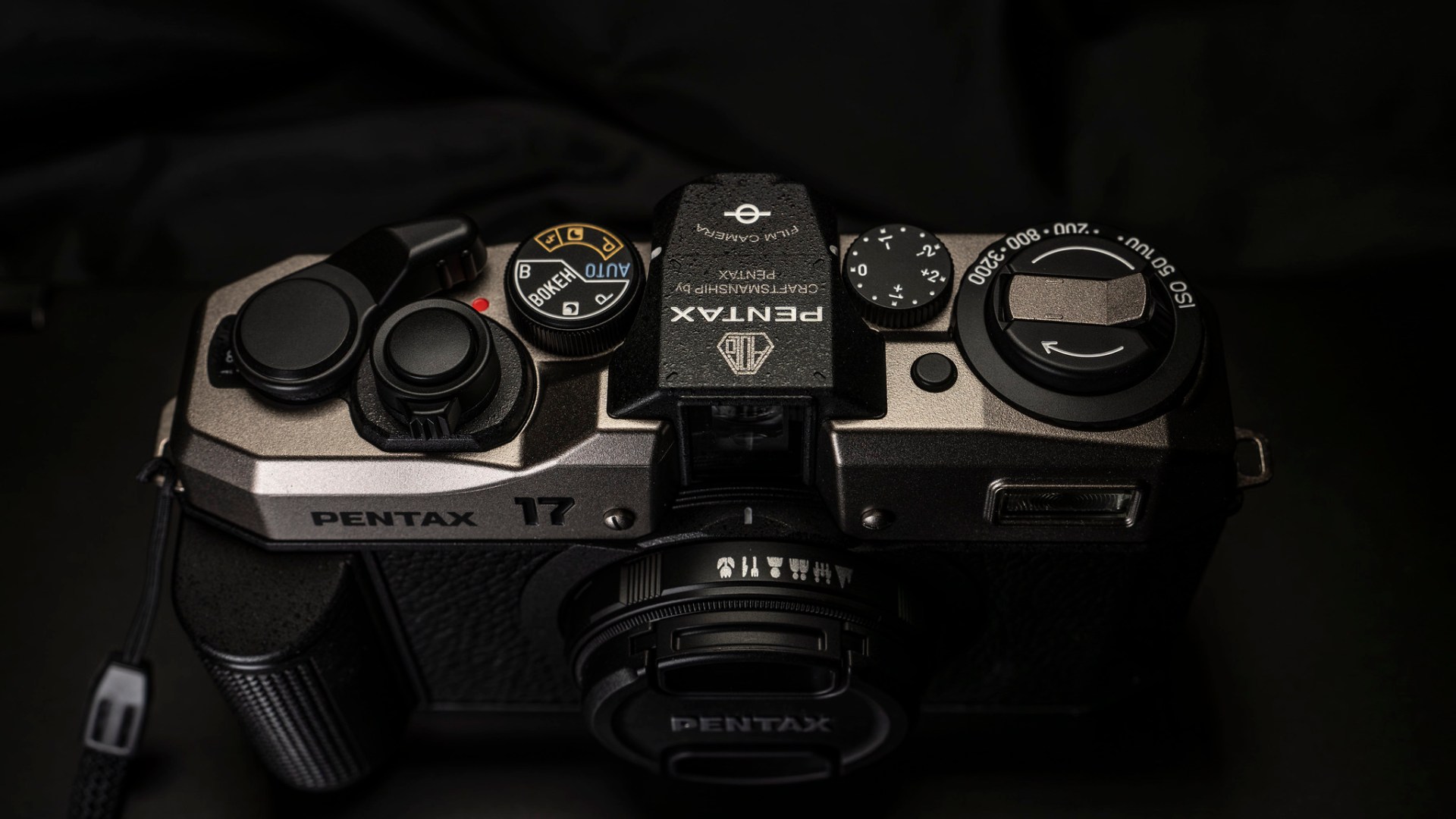
This is the follow-up thoughts post I mentioned in my last post. I wanted to give myself a few hours and some rest before jotting too much down.
My concern was that two things might impact my impartiality:
- Fanboying.
- An honest to goodness new film camera that I had been hoping for.
- Heat stroke.
- My luck, the camera arrived on a day when it was one hundred and eleventy degrees outside with a heat advisory in effect. Much rushing from A/C source to A/C source and a touch of flop sweating was involved. This is likely why my fat fingers showed up in so many pics due to rushing. Left the finger photos as is with some. I edited them out with others. I did not want my sweaty mitts not being able to properly hold a camera to take away from the image.
A day later after some rest I still really like this camera. So it was not a fanboy or heat stroke thing. Before I start gushing I will get the negative (singular) out of the way.
The black plastic where the pleather usually goes and the buttons and switches could use an upgrade in materials.

That’s it. That is all I have got.
Anything else I have seen folks complain about or question, I either get why Pentax did it or do not care. Let me list the ones I have seen with my thoughts.
Half frame and its impact on image quality.
Non issue in my opinion. From the impressive Olympus PEN FT (Review I wrote for KEH Spotlight back when I was a monthly contributor.) I once owned…
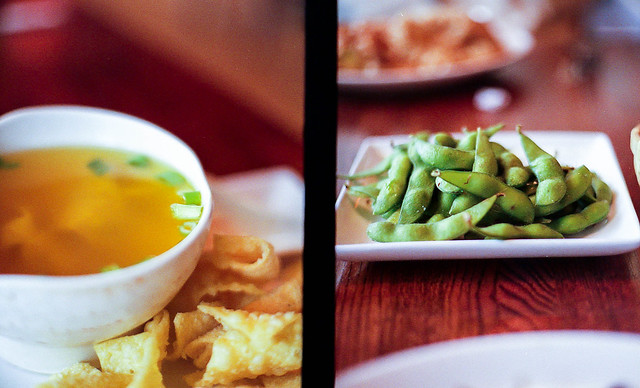
…to the humble Kodak Ektar H35 (Review I wrote for 35mmc.)…
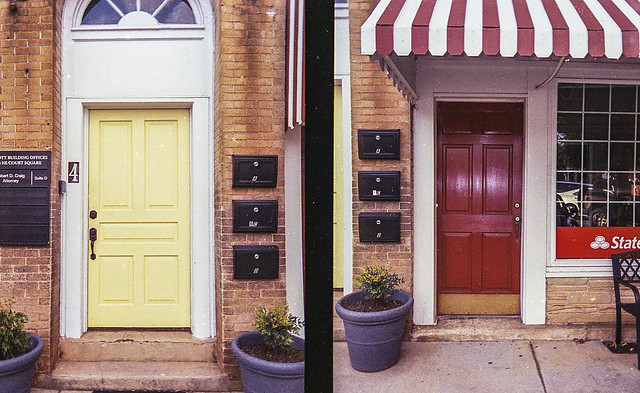
…I have never once been disappointed with image quality. As long as the lens is solid this should not matter much and that is definitely the case with the excellent lens in the 17. I imagine one day folks may be yanking this out to make an M mount variant which seems all the rage recently. It is that good. The lens is the star of this show in my opinion. Nothing else would matter if the lens did not deliver the goods and it does.
Portrait orientation.
Pentax’s reasoning was something, something the young uns and phones and whatnot. Ok. I like half frame a lot and a vertical orientation is part of the package. Some do not like this. But one can simply turn the camera…

…so not a big deal for me.
Too light.
I mean, I get it. I like it when a piece of kit has the proper heft to be used as a throwing weapon in a pinch… Theoretically of course. While I would not mind if it weighed a bit more to accommodate the materials upgrade mentioned above, I am not bothered by the light weight.
Price.
I do not get this one, honestly. Have you seen the price of some of these decades old non warranty having, might break if you look at them too hard with little hope of getting it repaired or could be charged an arm and a leg if you do, instathreadface darlings? Plus this is a wholly new camera designed from scratch, so I imagine the design, testing, and tooling costs were fairly substantial. The Industrial Engineeer (Yes. Third person. What of it?) that started his career working at the manufacturing plant for GE Steam Turbine Engineering (RIP. The legacy of Neutron Jack spelled its demise.) is impressed.
No manual controls.
What is the desired end result of controls? For me it is getting the desired image under certain conditions. I argue that a well thought out automatic control system can do as well as manual controls and that is the case here. More on this below.
But here is the main thing for me. Don’t like it? Don’t buy it. Why go all Captain Killjoy? To wit:
A company heard the request of film camera nut jobs like me and spent their time and energy producing a solid product, not something that feels toylike in hand while asking the user to deal with a number of compromises with little or no automation to be found like other companies have offered, that also does not cost like a used car. Heck, you have movie studios (cough… Warner Brothers… cough) killing completed films and projects in flight for the tax right off, other corporations carrying out wanton acts of malfeasance on the daily, and Pentax is out here trying to be a little bit of a bright spot in the world. Good on you Pentax.
Truth be told the camera did not have to be this good and I would have likely still bought it on general principle hoping they produce more and other companies follow suit.
On to what I like.
Number one is this.
They made it.
That was enough for me honestly. I was not all that optimistic. This is not Pentax’s fault. How many times have you heard of some camera announcement on the internets only for it to go up in smoke before anything comes to fruition. Some fizzle out with abandoned or disappeared web pages. Some accept early orders only to create a greatly delayed and sub par product. And some just say, yeah, nope. We are not doing that any more. But Pentax did the thing and I am glad about it.
The lens.


It is amazing. Excellent sharpness, colors, details, no darkness in corners or flares when shooting into the sun I could see. Also very flexible. This pic below is a favorite and shows its range.

Taken back to back it pulls off macro just fine as well as the wider scene in the second half of the diptych above.
Thinking this lens will likely go down as a legend one day.
Well thought out controls.
I will start with the mode dial.

Let me lay this out this way. I will call out the control dial setting and then translate it into how I would use a standard manual or semi automated (I.e aperture or shutter priority.) set up.
AUTO
Welp. Pretty much what it says on the tin. Camera decides everything. Whether flash is needed. What shutter speed and aperture is called for. But the big surprise for me was that this mode impacts focus as well. More accurately whatever zone focus mode you chose it will be ignored and pan focus will be employed. Or anything past the first few feet will be in focus.
Said another way the setting I leave it on when in hand. Essentially I just want a properly exposed pic with the highest likelihood of subjects being in focus mode.
P (Non flash)
You choose a focus zone and the camera sorts everything else. So standard issue program mode available on most cameras.
Night (Crescent Moon)
Optimized for low light long exposure pics. Tripod and remote trigger recommended. In my case the mode that may never be used. Glad it is there. Just not my cup of tea.
BOKEH
Aperture priority in my case. Or the only mode I used with the first roll other than AUTO. The 37mm full frame equivalent lens and f/3.5 aperture spec is modest but bokeh can be had.

I like it a lot. And it is a large reason why this camera is so fun.
P (With flash.)
For daylight photos with backlight where fill flash is desired. Nice. I can see myself using this fairly often.
Night (Crescent moon w/flash.)
Low light scenarios where you desire a long exposure to collect light from the scene along with flash to freeze the subject. Cool. Another mode that I am glad it has, but I do not see myself using it that often.
Exposure compensation and manual ISO control.


Self explanatory. Handy if I want to increase exposure for the subject in a backlit scene for instance.
Manual winder and on/off switch.

Materials notwithstanding the winder has a satisfying throw and both the winder and the on/off switch have a nice feel to their actuation.
Zone focus.

I have no complaints. It works. At such a wide focal length and modest aperture this is not a razor thin depth of field scenario. Not long after I started using this camera my brain was rewired to effectively turn this into a proper zone focus exercise. Way out, mountains. That is a bit far, people. A bit closer, two people. Hello there. Kind of close. Single person. Right in front of me, food. Macro, use the strap for distance. The instruction manual provides a table to help out,…
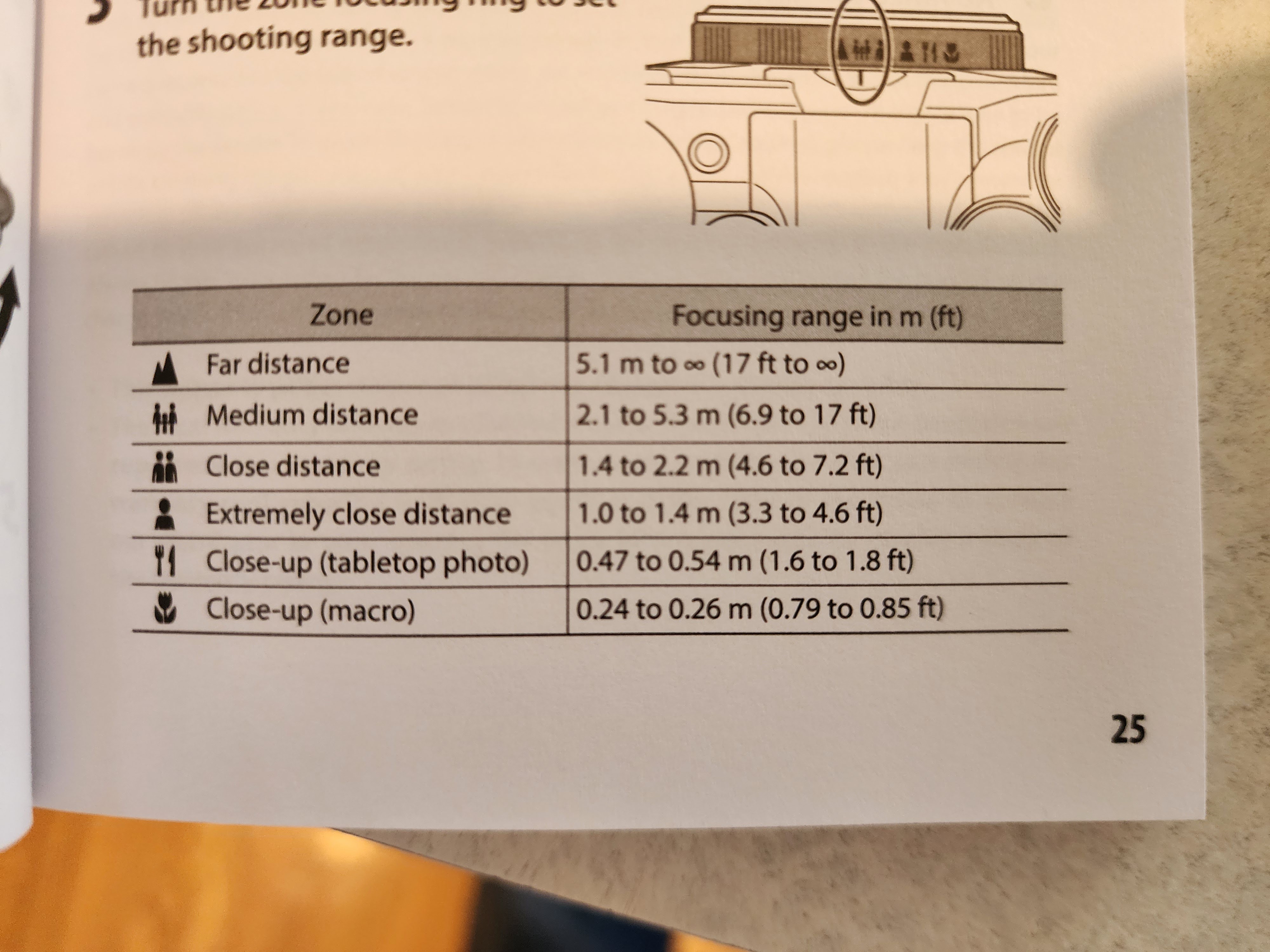
…but that is not really necessary since the same information is printed right on the camera body with a pointer to the distance that is currently selected.

Bottom line. It works.
Side note. The zone focus dial has no mechanical linkage to the lens itself. It is a preset. The lens does not move until you press the shutter. This reminds me of my Contax G cameras and I hope this means that, like that G camera, an AF Pentax film camera is on the horizon.
Viewfinder.

See those little frame lines above? They work. The smaller frame lines go along with macro and food focal distances. Use the larger frame lines for everything else. Is it spot on? No. They never are… except the dark magic viewfinder on the Contax G that is. It blocks the frame in the viewfinder to show a pretty accurate estimation of what will be in the frame… Can someone get Contax or whoever owns the brand name rights now and get them to… No. No. Let that go Eric. Be happy Pentax stepped up and let it go. Contax is not going to make an updated G. Ok. Moving on.

The viewfinder works.
Built in flash.

Much appreciated.
Half frame.
What some see as a minus I see as a plus.
Saves money.
More exposures per roll is cool.
<Self developing jag starts.>
But if economy is your concern real savings can be had by developing your own film. Not that hard and can greatly reduce your costs and I find it quite enjoyable. Same goes for scanning. Five rolls of color film would cost $25 to develop. Five roll of black and white would cost $50. Scanning five rolls in both cases would cost another $50. Meanwhile:
- Color chemistry good for up to 20 rolls of film costs less than $30.
- Black and white chemistry good for up to 15 or 20 rolls costs less than $20.
- A great scanner (Mine here.) is a one time expense that would pay for itself.
Still want to support your local camera shop. Buy the film and chemistry from them like I do.
<Close self developing jag.>
Exposure.
Nails exposure. That is it. I can ask for no more. I would not hesitate using slide film with this camera at all.
Diptychs.
I am an eight year old at times and the word is on my list of harmless words that seem like we should not say them amongst polite company, but I really like diptychs. Yes. I know any camera can be used to create diptychs but half frame cameras are so well suited to them. A friend asked me if I was going to buy rolls of film with less that 36 exposures. I said no, because I see half frame cameras as two pics for one event rather than an exposure for scene device. Along these lines every single pic on my first roll was a part of a diptych.

Ok. The last and arguably the least or most important depending on your way of thinking.
Looks.
Granted, functionality means the most. A beautiful useless camera is… well… useless. But that is not the case here and fortunately this is a good looking cameras also. So, it may be a bit light but it looks the business.


Well done Pentax.
For more sample photos see my first roll post.
Happy capturing.
-ELW


 Eric L. Woods
25 Replies to “This New Film Camera: Pentax 17 First Roll. First Thoughts.”
Comments are closed.