
Nonsense Comparison: Need vs. Want/MFT vs. Full Frame.
Let me get this out of the way.
A new-ish full frame camera and lens is superior to an over 10 year old MFT camera and lens. Of course.
That is not the discussion here.
But along those lines any number of brand new midsize luxury or even more pedestrian brand sedans are superior to my years old little family sedan.
But, I am perfectly happy with it.
Has been reliable, drives well, gets great gas mileage, and looks good while doing it.
But if I did have a high end luxury sedan and could afford it I might want a more pedestrian sedan for day to day use. Not a part of my reality with cars but it is possible with cameras.
For years I sought to create a full frame daily carry solution. My first stab at it was the very nice Leica Q.



There were two issues:
- Way too precious for me to feel comfortable using it as a daily carry camera.
- Through human error I misplaced this camera once. Got it back but I sold it not long after.
- It was not the Leica I wanted.
- I did not simply want a camera with the Leica name on it. I wanted an M mount digital rangefinder.
I eventually nailed down the A7C as the body I wanted and after much trial and error, I identified the Sony 40mm f/2.5 G as the perfect fit for my purposes.
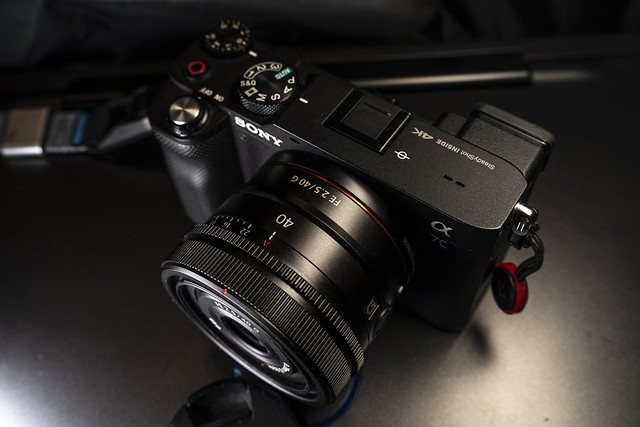


For me personally… (Look away Leica adherants.) …this was a superior solution. But there was a problem for me here also.
- Too good.
- I know this does not make sense. But I found using this set up for daily use was like using a sledgehammer to drive in a thumbtack.
- Also pretty precious.
- I want a literal knock around camera. This camera is not that. It is my back up camera in my kit for “real” work. It costs too much to easily replace if I should drop it or if it grows legs while I am out and about.
So, what to do?
Still insisting on full frame I went the vintage route. The Canon EOS 5D.


It was great fun. It produced wonderful images and I even wrote a 35mmc post about it. But after the DSLR nostalgia haze wore off I had to face facts.
- Too big.
- As much as I tried to overlook this obvious issue for my use case I finally had to admit I was not carrying it with me because it was a bit of a bus.
- …that’s it.
Psst…
In the end, it seems this was all an elaborate ruse by my subconscious to get my mitts on the Canon STM 50mm f/1.8 and MC11 adapter for Sony again.
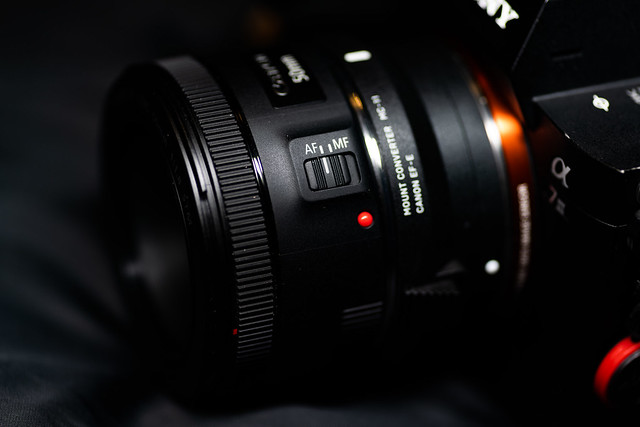

I thought the humble MP count or noise at higher ISOs would be problematic, but they were not. 12.8 MP did just fine and LR AIDenoise took care of any high ISO noise concerns. Fortunately by the time I had made peace with this the next contender was already in hand. In fact I took photos of it with the EOS 5D.

This inexpensive 2009 camera turned out to be the perfect candid solution.


I expected to like the GF1. I did not expect to like the GF1 so much that I would basically abandon the EOS 5D. All I needed wanted was an EVF. Similar to the EOS 5D MP count was not an issue and high ISO noise was handled just as well with Lightroom AIDenoise. So with no hesitation, I sold the EOS 5D kit and picked up the topic of this post.

This is it.
The A7C or full frame is what I wanted for daily use. But this is all I need for a daily carry camera.
MFT is just fine for daily use.
And it even has advantages over the cameras above.
Leica Q and Sony A7C
- Smaller.
- Much less dear, so perfect for knocking about.
- Built in flash.
- Tiny high quality lenses.
- Tilting EVF.
Canon EOS 5D
- Much smaller.
- Built in flash.
- Tiny high quality lenses.
- IBIS.
- Tilting EVF.
One who has followed this blog space might ask:
After using MFT over the years how have I only now realized that it is the daily carry system for me?
I am glad I imagined you asked.
The short answer is that Panasonic is better suited to my needs and preferences than Olympus.
- The Olympus 17mm f/1.8 is a pleasure to behold, but I rarely made use of the AF/MF clutch and much prefer the 40mm full frame equivalent Lumix 20mm f/1.7.
- The close focus, small size, and excellent IQ of the 20mm is an unbeatable alternative for me.
- I prefer the Lumix 14-42mm power zoom over the Olympus 14-42mm power zoom or Panasonic’s 14mm f/2.5 pancake prime.
- Between the zooms I prefer the Lumix’s toggle switch over the zoom ring and the Lumix feels better in hand.
- The flexibility of the zoom is an easy compromise for the slower aperture.
- I prefer the Panasonic 42.5mm f/1.7 O.I.S. lens over the Olympus 45mm f/1.8.
- As good and possibly better IQ. I particularly like the bokeh balls and transitions between in and out of focus areas.
- Much closer focus distance makes for a more flexible lens.
- While lacking IBIS I prefer the Lumix GF1 over my first MFT camera, the Olympus E-PL5.
- I prefer the EVF having Lumix GX7 over the Olympus E-P5.
- If the E-P5 had an EVF I may have never left Olympus MFT. It was my favorite Olympus camera performance and form factor wise but requiring an add on EVF was a deal breaker.
And this is great news for those seeking an affordable on ramp to digital interchangeable lens cameras. The GF1 and GX7 are the types of cameras I wish Panasonic and Olympus were leaning into now rather than releasing higher end cameras that rival the size and price of larger sensor solutions.
As I stated at the beginning I stated the obvious. Full frame is better. Full frame is what I want. But it is an option. MFT also meets all of my needs.
That is about it.
Happy capturing.
-ELW

Sample GX7 Pics.


 Eric L. Woods
One Reply to “Nonsense Comparison: Need vs. Want/MFT vs. Full Frame.”
Comments are closed.