
A while back I was minding my own business when 35mmc put up a post about the NONS Instax back for Hasselblad. Read the article and at first, I did not fully get it. <Engage cut and paste.>
A very nice concept, but at $279 ($259 pre-order) it costs more than a full blown Instax Square camera from Fuji. So get that, right?
This is where I should have walked away.
But, no. I got the bright idea to write a “So…” post about it. These are posts where I share my personal opinion about products that do not appear to be up my alley. “Great products for some, but not for me.” posts. This requires research because I wanted to make a decent case for my stance. Well, that backfired spectacularly.
This is specific to selecting an Instax square solution. In no particular order here are the things that swayed me.
- Fuji cameras.
- The aperture spec for the Instax Square cameras is f/12.6… Eesh. Really?
- Zone focus. Fine. Two zones? Eesh.
- Mint option.
- While it is a looker and the ability to focus properly was intriguing, $899 for a lens that tops out at f/5.6 is a no from me.
- Non… NONS Hasselblad back option. Vinstax.
- Quite a bit more expensive ($799) and requires a viewfinder adapter and a filter according to a review I watched and the tutorial video posted by Vinstax.
- Still an impressive engineering feat but the ability to use the NONS solution without adapters combined with the lower cost is hard to ignore.
- Old time Polaroid backs.
- Made for old time large format Polaroid film that covers a much larger surface area. There are great videos that all caused me to glaze over (Another good one here.) before I reached the end because… while the videos themselves are great, I am not doing all of that. I much prefer a film surface area that better matches the 6×6 image surface and is still in production.
- NONS full Instax Square camera kits.
- While less than the Mint variant above and, thanks to using interchangeable lenses, having access to much faster glass I find the 1/250s top shutter speed a bit problematic with ISO 800 film.
- NONS Instax Square Hasselblad back.
- After researching everything above $279 starts to sound reasonable with one big assumption. That you already have a Hasselblad camera. You could easily spend far more for a native Hasselblad film back. But if you do not have a compatible Hasselblad V camera body, none of this makes any sense and I would likely go with the Fuji cameras or the NONS SL660 depending on my budget.
- After saying all of that everything I needed to sell me was contained in one video.
- Instax square nicely matches the 6×6 surface area.
- Focus seems accurate.
- I like the rechargeable battery and digital counter readout.
- Comes with a dark slide.
- No adapters are needed for the viewfinder or lens.
- Shoot as you would any other film.
With that, I pre-ordered one.
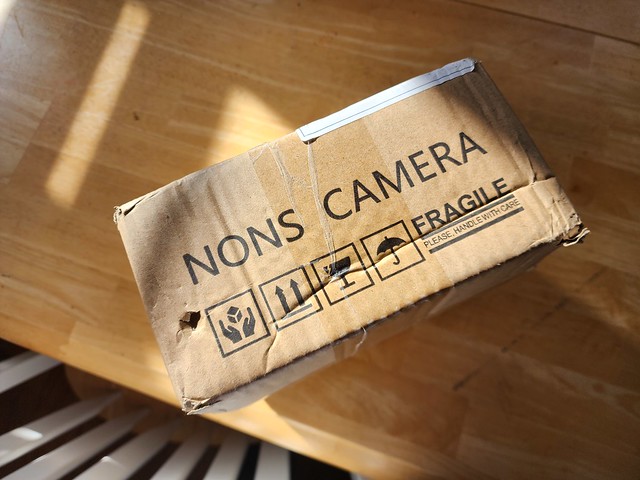
I will cut to the chase. I am impressed. The packaging was simple, but well done nonetheless. I rarely make unboxing videos, but it seemed appropriate here.
It is a very good aesthetic fit for the all-black Hasselblad 501c.
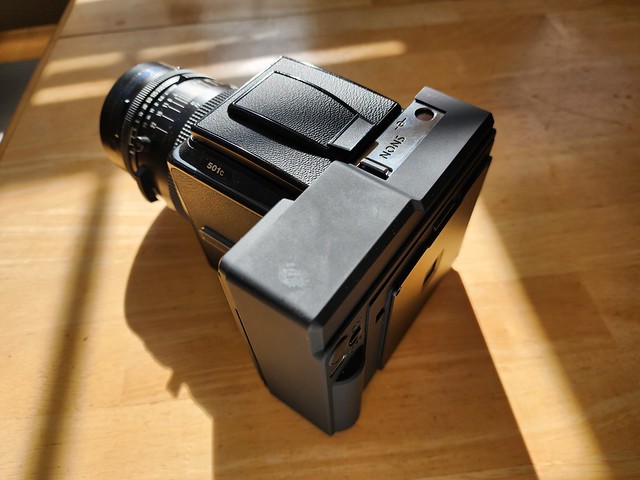

Also made a video showing how easy the NONS Instant Back attaches to the camera body.
And lastly here is a video showing how easy it is to load the film.
Alright, let me try to run through the pros, cons, and thoughts.
Pros
- First and foremost this back does not ask much of the user.
- No spacers, adapters, or lens filters of any kind are needed.
- Simply attach the back, power it up, load it, meter, focus, and go.
- The only ask is that you eject the exposure with a simple button press (Similar to ejecting the card in the last video above.).
- Want a double exposure? Take another pic before ejecting the film. Simple.
- Looks good on camera and gives a bit of a grip where the film ejects.
- Well built with most interlocks such as the shutter being blocked when the dark slide is in place.
- Seems it will let you remove the back if you do not have the dark slide in place. Luckily the release button does not seem prone to accidental presses.
- Comes with a dark slide and has a dark slide holder.
- Has a rechargeable battery charged by USB-C.
- Assuming one has a Hasselblad already it is reasonably priced.
- You could easily pay more for a regular Hasselblad film back. You know… with no battery… or electronic screen.
- Oddly now having used this unit I would definitely consider the SL660 if I did not already have a Hasselblad.
- Has a helpful battery meter and exposure counter that look good and is set in a rather bit of metal finish.

Cons
- I got nothing.
The only slight I can muster has nothing to do with this film back or camera and everything to do with the film. But first the positives about the film. This is all new to me because I only used Polaroid instant cameras before and had never tried Instax. So here we go with the positives.
Pros
- Great colors. Reminds me of slide film.
- Maintains more detail than I had expected, honestly.
- All of which supports the notion I have read saying that the film surpasses the capabilities of the native cameras made for it.
- Not all that expensive actually. $20 for two 10 packs, or $1 a frame.
- Many 120 films cost about the same or more and with Instax there is no developing process or expense.
- ISO 800 is great.
- Allows for interior and exterior use.
- Readily available.
Cons
- Dynamic range leaves one wanting.
- Neither shadows nor highlights are recoverable.
- Expected with scanned instant film. But a factor to be considered.
- Also reminds me of slide film. You need to get it right.
- If a scene has great variations in lighting you will likely lose what you have not metered for.
- Spot metering is your friend.
- Neither shadows nor highlights are recoverable.
This is not a complaint. Just something that needs to be taken into account. The advantages far outweigh the negatives here. Once I realized this, I reframed a few pics below to reduce the variance in lighting within the frame.
Most importantly, I understand one fact. This is instant film. Proper negative film will always perform better. This is a different thing and I am ok with that. Enough of that.
<End cut and paste.>
I did a bit better with the exposure with my last roll. Eight of ten came out to my liking. WIll post both the full Instax scan and a crop to image square.


<More cut and paste.>
As I have said before, even though two pics were over or under-exposed, I was staggered that I was getting images every time. I am glad I have started figuring out how to meter for this film. When you hit the sweet spot, like the last photo above, I really like the results.
Parting thoughts?
Out of curiosity, I made the mistake of looking at a few comments here and there. Some pointed out things like, “Is there a way to get rid of the dark square?”. Someone else mentioned trying to make a use case for this device…
I think folks are forgetting something. <ahem>
None of this makes any sense.
<deep breath> In an age where nearly any random mobile phone can produce a decent image for free.99 affixing an instant film back to a priced to ridiculousness medium format film camera to then scan that physical image in hand so that I can share the images online and write this ramblefest we are no longer dealing in sensible matters.
This is about fun.
And this NONS Instant Back is the most fun I have had in a while. The images are gravy.
I am stunned that NONS made this. And even more stunned that they made it so well.
Well done NONS.
Do I recommend this? Depends.
Do you have a grasp of your better senses? If your answer is yes… then no. Run.
But if you are similarly afflicted as I, and already possess a Hasselblad body, then I am surprised you have not purchased one already. What are you waiting for?

Happy capturing.
-ELW

 Eric L. Woods