
Warning:
Pure nonsense ahead.
Preface:
For years I have wanted a digital/analog shared mount solution.
What am I on about?
I wanted as close to a near identical experience with a system whether I chose to go with analog or digital on a given day.
What does this mean spec wise?
- Same mount.
- Same lenses.
- Same controls (within reason).
- Same handling.
- Same IQ aesthetic.
- Same image capturing surface area.
Cheap…Inexpensive…Relatively affordable.
I eventually gave up. Let’s take a walk down memory lane.
Sony A Mount
Arguably one could say that my first attempt was with Sony. Sony started with the digital camera game by taking over Minolta’s A mount. They pivoted from DSLR to a translucent mirror/mirrorless solution. Said another way a fixed mirror that was just opaque enough to reflect light to the metering and AF sensor. A fixed mirror box instead of a flippy mirror (Impressed by this technical jargon?) if you will.
Technically worked. It resulted in some fine images like this one that made Flickr Explorer (When I had no idea what it was and had no idea I was on it until I saw a bunch of comments saying congrats. And still had to Google it.).

Why it did not last:
- LA-EA4 adapter was a beast of a thing to slap onto the front of a tiny Sony A7 body.
- DSLR lenses are a bit large to be paired with such a setup.
- Available A mount film cameras were Minolta vintage and had nothing in common with Sony FE cameras.
- In the end, I just preferred using Sony FE lenses with Sony A7 bodies.
Minolta A Mount
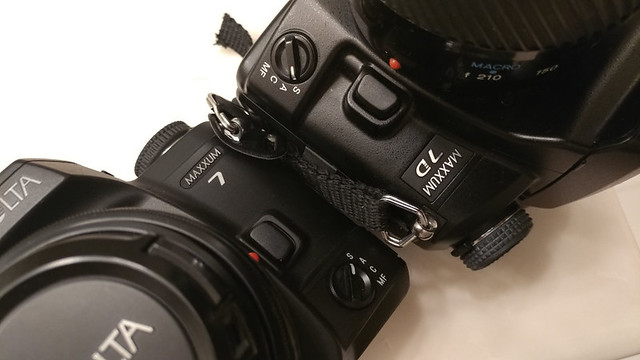
This A Mount rabbit hole did not stop there. I tripped over a Minolta Maxxum 7D at my local camera shop. I did not know that Minolta (Konica/Minolta at this point) made a digital camera. Around the same time I acquired a Minolta Maxxum 7. Virtual twins looks wise.


Sample film MAXXUM 7 photos:


Sample digital MAXXUM 7D photos:


Why it did not last:
- 6 MP was not going to cut it.
- IQ of the digital 7D was not quite there.
- Weirdly, even though they looked so similar, the film variant felt more advanced and better put together than the digital one.
- That post above details an insanely deep custom menu system on the film 7 while the 7D has a pretty straightforward bare bones digital camera menu.
- Take a look of the front camera pic above. The film 7 has touch sensitive sensors that activate the camera when you pick it up.
- The film 7 feels much better in hand than the 7D.
SIGMA SA Mount
This was a two time “They made what now?” event.
- They made a SIGMA interchangeable lens SA mount Foveon sensor camera? Buys sd Quattro.
- They made a SIGMA SA mount SLR? Buys SA-7N.
That about does it. Still have both.
This setup does make for some interesting gear combinations. For example, along with an MC11 adapter for Sony, it allows for use of a film SLR era lens…

…with SIGMA film camera…


…, SIGMA crop Foveon digital camera…


…, and Sony digital full frame.

Why it did not last:
- The SA-7N pulls right up to cheap feeling in hand once the novelty wore off.
- Technically it did last since I have these lenses still. But ergonomically and functionally these cameras are nothing alike so they do not feel a part of a coherent analog/digital system.
The last bullet is the main “issue”. Even though I can use these lenses with three different cameras, the cameras are so different that they feel like wholly unrelated experiences.

The 645D was a fun distraction. Had wanted to use a digital medium format camera for years. In the end, I had to buy one to do so. Great camera, capable of great results.


Using the same lenses with film was a definite benefit.


Why it did not last:
No fault of the 645D but that Sony lens fully displaced it functionally.


Had the 645D not been so valuable I might have kept it. But with the Sony lens fulfilling the need combined with my preferring to use the film 645N if given a choice between the two and it being another camera to carry that led to it being traded towards a Sony upgrade as I chose to lean into that system. So only the 645N remains.
Now to the main topic for the day.

And we have arrived ladies and gentlemen. Two cameras that are very much alike in use.
The crazy part is that this was not by design. I did not set out to do this. I was supposed to buy one old timey DSLR and a nifty fifty and that was going to be it.

No other camera was planned initially. Then after the EF 50mm f/1.8 I opened with…

…then came my all time favorite, have owned it in every mount available, Tamron 28-75mm f/2.8…

…which was then followed up with a Canon EF 85mm f/1.8 USM.

So throw in a second hand Godox flash TT685 I picked up for peanuts at my local camera shop and I had myself an affordable little digital camera system. More than what I planned to pick up but none of it cost much so I am good, right?
Nope.
That annoying gadget acquisition syndrome voice then whispered in my ear:
“You know what else would be great? What if you can find an inexpensive EOS SLR?”
Fine. As I stated in my first post about this camera, I set up some ground rules and a wish list in advance.
- $100 or less.
Ok. I had one ground rule. What of that wish list?
- 1/8000s shutter speed would be nice.
Ok. I had one wish list item.
The result.

Soon after it arrived, I realized I had stumbled upon the shared mount kit I had been looking for. It really dawned on me when more than once I reached for one thinking it was the other.
It met every single one of my requirements.
- Same mount.

- Same lenses.
- Same controls (within reason).


- Same handling.
- Same IQ aesthetic.
- I really like the way these old DSLR sensors render.
- Same image capturing surface area.
- The closest I came up to this point was the 645 twins, but the digital sensor in that case is a bit smaller. Here we have a true apples to apples scenario.
Cheap…Inexpensive…Relatively affordable.- This whole kit below was less than $870.

$870 for two cameras, three lenses, and a flash. The grip was a freebie from my local camera shop. They are the best.
This is my camera nerdery dream kit. Handling is nearly identical. AF and AE performance is nearly identical. The resulting image quality is nearly identical. Here are sample images with each lens with each camera.
Canon EF 50mm f/1.8
EOS A2


EOS 5D


Tamron 28-75mm f/2.8
EOS A2


EOS 5D


Canon EF 85mm f/1.8 USM
EOS A2


EOS 5D


So that is it. I found it. And I am very happy with it. I believe it is the least expensive outcome for such a system. Full frame came a bit later for other brands so their systems would cost a little more.
Since acquiring them both cameras have seen regular use. Not only are they great to use they also do away with my normal feature/value/fragility issues.
Other cameras lack features.
- Here AF and AE is available but fully manual is available as well.
There are other cameras that cost so much that daily use is off the table for me.
- Both of these cameras are plentiful on the market for reasonable prices.
There are other cameras that are fragile or lack a path to repair.
- They are plenty sturdy but if they did break I would just buy another at these prices.
So I found what I was looking for.
Wrap up.
Most important to me is that this is a system that is reasonably priced and not at all precious so I have no hesitation bringing it wherever I go.
This may be a use case very specific to me. I am not sure if such a well matched analog/digital dual camera system would be something anyone else would be interested in.
But if you are, I believe this is a fine example.
-ELW


 Eric L. Woods
2 Replies to “This Old Camera/Vintage Digital: How I Accidentally Backed Into An Analog/Digital Shared Mount Solution.”
Comments are closed.